The short answer
The DET-2000 measures earth resistance and soil resistivity with four terminals, on a 3½-digit display. Pick the range whose lower scale comfortably covers the value you expect to read. For most earth pits, 0-20 / 200 Ω is the safe choice. Add the testing kit (spikes, wire, hammer), which is not supplied with the instrument.
Why earth resistance matters
An earth electrode gives fault current a low-resistance path into the ground. If an earth pit has dried out, corroded or been disturbed, its resistance rises. A fault can then fail to trip the protection, and exposed metalwork can stay at a dangerous voltage. Standards and utilities therefore set limits and require periodic measurement. The values asked for vary widely with the installation, from around 1 Ω for power stations and major substations to higher values for smaller installations, so check the figure that applies to your site.
How an earth tester works
An earth tester cannot simply put a meter across the electrode, because the ground itself is the other half of the circuit. Instead it injects a small alternating current into the soil between the electrode under test and a second, auxiliary spike, and measures the voltage drop using a third spike. From the current and voltage it calculates resistance. This is the three-pole fall-of-potential method, and it is what the DET-2000 uses. The two auxiliary spikes are driven into the ground in a straight line away from the electrode.
The DET-2000 at a glance
- Measures earth resistance (three terminals) and soil resistivity (four terminals), E1, P1, P2 and E2.
- 3½-digit LCD, with a low-battery indicator.
- Rechargeable Ni-Cd battery charged from the supplied cord. A carrying case and manual are included.
- Accuracy of ±1.5% in the middle of each range (10% to 90% of range) and ±3% at the ends, as specified per IS 9223.
- Rugged ABS body, hand-held or on a bench, about 575 g.
- 2 kV AC dielectric test between circuit and case.
Choosing the range
The DET-2000 comes in dual-range and triple-range versions. A dual-range model has a low range for good earths, where you want fine resolution, and a high range for poor earths or soil. A triple-range model adds a middle step. Read the name left to right: 0-10 / 100 Ω means a 0 to 10 Ω scale and a 0 to 100 Ω scale.
| Range options | Type | Suits |
|---|---|---|
| 0-5 / 500 Ω | Dual | Very low-resistance earths, with a wide high range |
| 0-10 / 100 Ω | Dual | Good earth pits and electrodes in most installations |
| 0-20 / 200 Ω | Dual | General purpose, a safe all-round choice |
| 0-10 / 1000 Ω | Dual | Higher-resistance ground or soil resistivity checks |
| 0-20 / 2000 Ω | Dual | Poor or dry soil |
| 0-200 / 2000 Ω | Dual | Soil resistivity and very poor earths |
| 0-5 / 50 / 500 Ω | Triple | Fine resolution from very low to high |
| 0-10 / 100 / 1000 Ω | Triple | One instrument for earth pits and soil |
| 0-20 / 200 / 2000 Ω | Triple | Widest coverage for mixed work |
Other ranges can be arranged on request. Call us if your range is not listed.
A simple rule: choose a range where the reading you expect sits in the lower half of the lower scale. If your earth target is 5 Ω, a 0-10 Ω scale reads it with the best resolution. If you survey sites with very different soil, a triple range saves buying twice.
What you need to buy with it
The DET-2000 is supplied with its carrying case, charging cord and manual. The testing kit is a separate accessory: four mild-steel spikes (45 cm), four spools of flexible wire (10 m, 20 m, 20 m and 30 m) and a hammer, in one bag. You need it to run the test, so add it to your order.
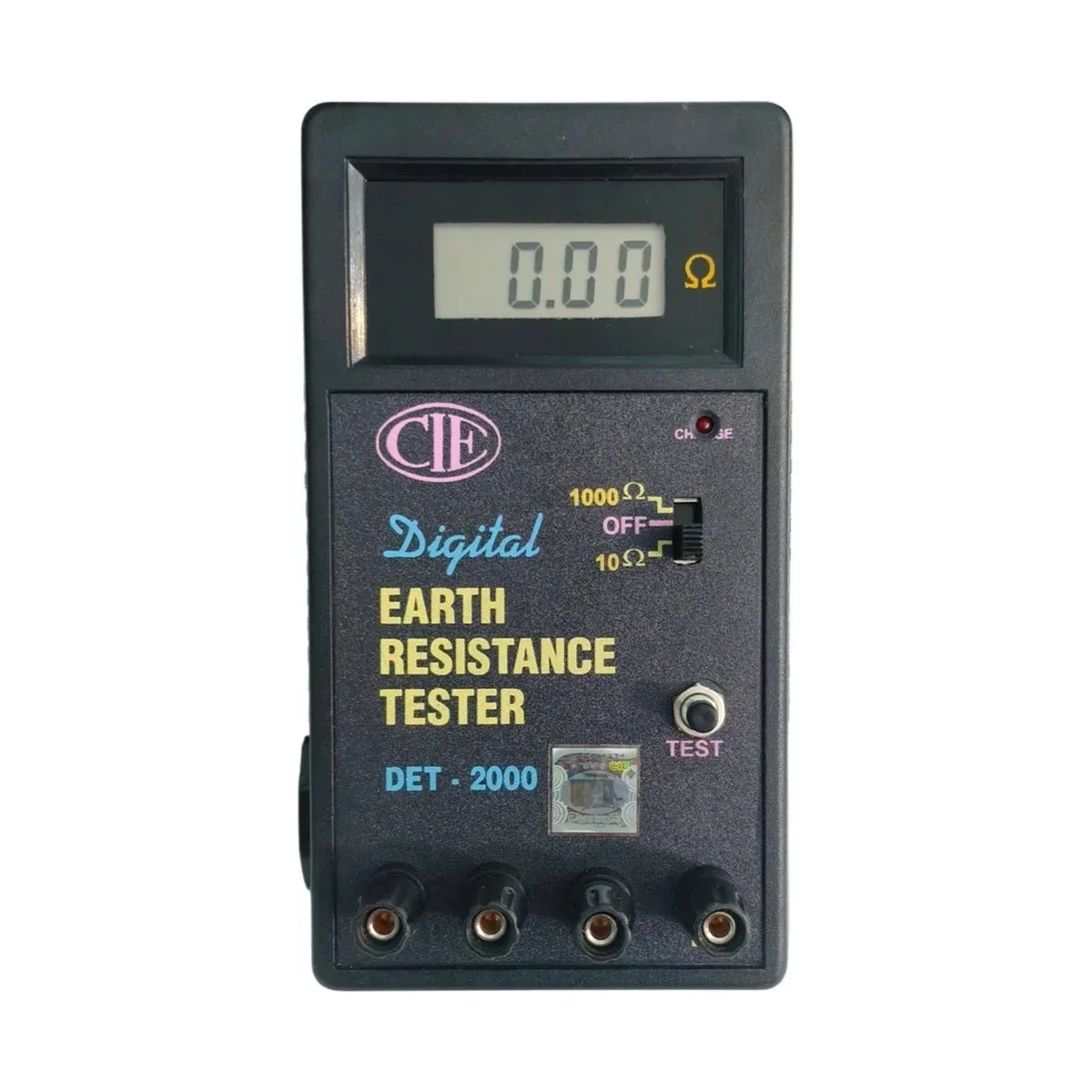
Digital earth tester
 DET-2000
Digital Earth Resistance Tester
Four terminals for earth resistance and soil resistivity, clear digital reading, rechargeable. Choose your range on the product page and add the testing kit.
From₹4,530
₹6,800 33% off
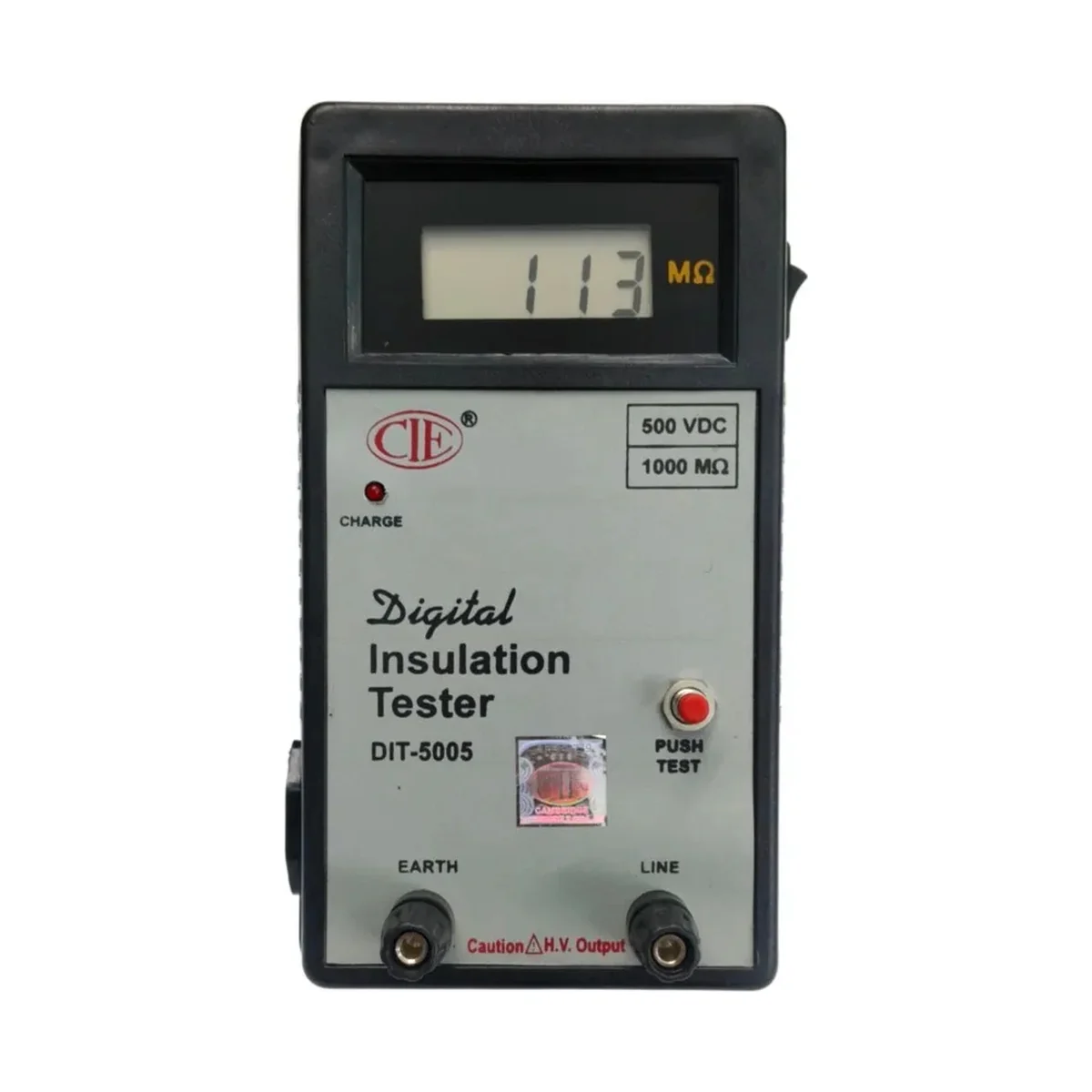
Pair it with an insulation tester
DIT-5005
Digital Insulation Tester
Most electrical maintenance work needs both: earth resistance for the grounding system and insulation resistance for the equipment.
₹4,530
₹6,800 33% off
What is the difference between three-terminal and four-terminal use?
In the three-terminal method you short E1 and P1 and connect them to the electrode, which gives earth resistance. In the four-terminal method you use all four spikes in a line at equal spacing, which gives soil resistivity, used to design a new earthing system.
Can I measure earth resistance with a clamp meter or multimeter?
No. A multimeter cannot make this measurement because the ground is part of the circuit. You need an earth tester with auxiliary spikes.
How often should I test earth pits?
Many sites test at least once a year, and again after heavy monsoon, long dry spells or any work near the electrode. Follow your site or utility rule.
Does the battery last?
The Ni-Cd battery is rechargeable from the supplied cord, and a low-battery indicator shows when it needs charging.